Logistics & Trade · June 8, 2026 · 6 min read
Buying Tile by the Container: A First-Timer's Guide
Updated July 2026
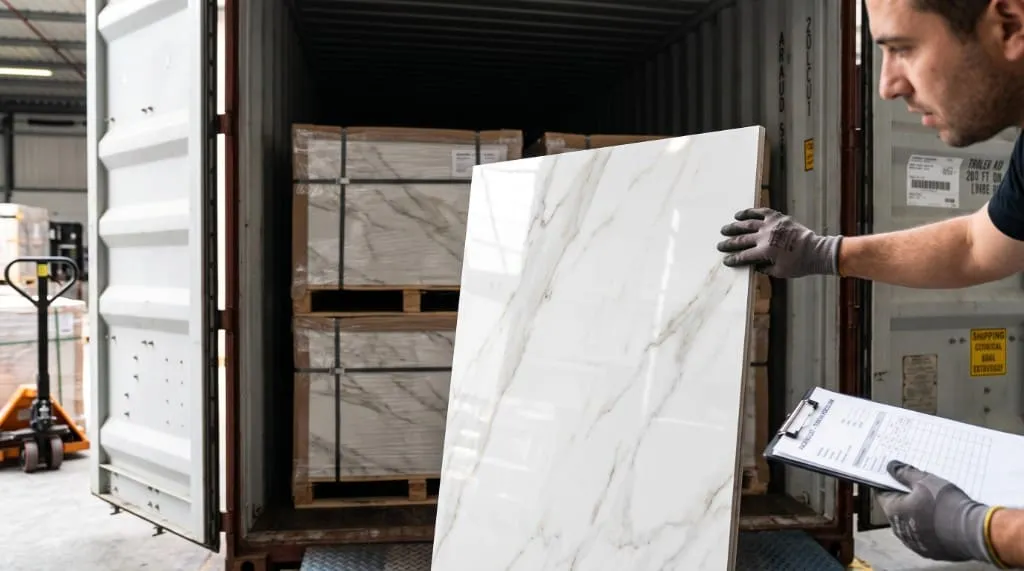
A 20-foot container is the standard unit of the imported tile trade: mills sell by it, freight is priced by it, and in US-road-legal loading it carries roughly 800–900 m² (8,600–9,700 sq ft) of large-format porcelain — about 19 to 21 pallets, capped by weight long before space runs out. Whether buying one directly makes sense depends less on your appetite for savings than on your appetite for process: documentation, inspection, and receiving discipline are where container buying is won or lost.
This guide walks a first-time buyer through the whole arc — who should do it, the math, the money, the calendar, and the paperwork — based on how we run Turkish programs at GoodzHub.
Who should import direct (and who shouldn't)
Direct container buying rewards three kinds of operations: distributors and slab yards that turn inventory continuously, builders with a pipeline of projects that can absorb a full load of a few SKUs, and retailers building an exclusive line they intend to reorder. The common thread is repetition — the fixed effort of importing amortizes across containers, not within one.
It punishes one-off buyers. If you need 400 m² (4,300 sq ft) of one surface for one project, a container's minimums force you to buy double what you need across SKUs you didn't choose. Pallet-quantity purchasing through an importer's stocked or consolidated program almost always beats a forced container. There is no prize for importing badly.
Container math, with real numbers
Tile containers cube out on weight. A 20ft box can physically hold more tile than US roads will legally carry: once the container is on a chassis, cargo is effectively capped around 19,000–20,000 kg (42,000–44,000 lb) for standard permits.
Worked against our own pallet specifications:
- 60×120 cm (24″×48″) porcelain — pallets of 43.2 m² (465 sq ft) at 1,020 kg (2,249 lb): about 19 pallets ≈ 820 m² (8,830 sq ft).
- 60×60 cm (24″×24″) porcelain — pallets of 43.2 m² at 930 kg (2,050 lb): about 21 pallets ≈ 907 m² (9,760 sq ft).
- 2 cm (3/4″) exterior pavers — heavier per square meter; expect meaningfully less coverage per box, planned case by case.
Mixed-SKU containers are normal and sensible — a distributor's first load might run three collections across two formats. What you should not mix casually is firing lots of the same SKU: shade and caliber consistency within an order matters more than squeezing the last pallet in.
Landed cost, dissected
The mill's price is the beginning of the number, not the number. A realistic landed-cost build for Turkish porcelain into New Jersey stacks like this:
- EXW / FOB price — the quoted tile cost at the factory or Turkish port.
- Ocean freight — Turkey to the US East Coast, priced per container and genuinely volatile; quote it fresh, never budget from last year.
- Duty — porcelain tile enters under HTS chapter 69 at a base rate in the high single digits, plus whatever trade measures apply at entry. Confirm the current rate with your customs broker at booking, in writing. (This is the line that removed China from the market; treat it with respect.)
- Entry costs — customs brokerage, the importer's bond, merchandise processing and harbor maintenance fees. Modest individually, real in total.
- Port and drayage — terminal handling at Newark–Elizabeth and the truck to your dock. Short drayage is a quiet advantage of NJ-based receiving; the same container railed inland adds cost and days.
As a sanity check, first-time buyers should model landed cost at a comfortable margin above EXW and be pleasantly surprised, not the reverse. If a quote's landed math looks too clean, a line is missing.
The calendar: order to door
Updated July 2026. For direct-mill production shipped to the East Coast:
- Production: 3–4 weeks for a standard run (stocked series ship immediately).
- Inland haul, export clearance, vessel cutoff: about 1 week.
- Ocean transit: 25–35 days, Turkish ports to New York/New Jersey.
- Discharge, customs release, drayage: 3–7 days when documents are clean.
That is the six-to-eight-week figure the trade quotes, and it holds — when nothing is late. Build project schedules with a two-week buffer, and never let an installation date depend on a vessel that hasn't sailed. One document worth knowing by name: the ISF ("10+2") filing, which must be transmitted to US customs before the container is even loaded in Turkey. A missed ISF means penalties and delay before the tile touches water; a competent broker or import partner handles it invisibly.
Documentation and inspection
Four documents move every container: the commercial invoice, the packing list, the bill of lading, and the certificate of origin. Add the mill's test reports — water absorption to ISO 10545-3, DCOF or R-rating where slip matters — and lot documentation tying box labels to shade and caliber codes.
Inspection belongs at the origin, not the destination. Approve production samples from the actual run, and require loading photographs: pallet corners, strapping, dunnage, the closed doors with seal number visible. Every requirement in this paragraph costs the mill an hour and can save the buyer a five-figure dispute. Our sourcing guide covers the verification checklist for Turkish mills in more depth.
Receiving: the 48 hours that decide claims
Freight damage is a when, not an if, across enough containers — and claims are decided by receiving discipline, not by who is right.
- Photograph every pallet before signing anything, from angles that show wrap, corners, and any lean.
- Note visible damage on the delivery receipt or BOL in specific words — "3 pallets, corner crush, boxes exposed" — not "subject to inspection."
- Count pallets against the packing list at the door.
- Report concealed damage fast: many carrier and insurance windows run as short as 48 hours from delivery, and silence reads as acceptance.
- Keep the damaged material; claims adjusters cannot assess a dumpster.
None of this is complicated. All of it is skipped constantly, usually on the busiest receiving day of the month, which is why it belongs in your warehouse's written procedure rather than anyone's memory.
The managed-program alternative
Everything above is the work. Some buyers want it; most want the result. A managed import program splits the difference: the buyer chooses collections and volumes, and the import partner runs sourcing, inspection, documents, customs, and claims under one accountable roof — landing the container at the buyer's dock or releasing pallet quantities from NJ.
That is the model GoodzHub runs from Lyndhurst, twelve miles from the Newark–Elizabeth terminal, across 72 Turkish collections. Program structures for distributors — including exclusive series and reorder continuity — are outlined on our partners page, and a conversation costs nothing: request a quote with your formats and target volume.
FAQ
- How much tile fits in a 20ft container?
- Weight-limited to US road rules, roughly 19–21 pallets: about 800–900 m² (8,600–9,700 sq ft) of standard-thickness large-format porcelain. Heavier formats, such as 2 cm (3/4″) pavers, carry less coverage per load.
- What does a container of tile weigh?
- Loaded to US road-legal limits, cargo runs about 19,000–20,000 kg (42,000–44,000 lb) — the constraint is weight, not space.
- How long does importing tile from Turkey take?
- Six to eight weeks from order to an East Coast door for direct-mill production: 3–4 weeks of production, 25–35 days on the water, and up to a week for clearance and drayage. Stocked programs ship in days.
- Can I mix different tiles in one container?
- Yes — mixed-SKU containers across collections and formats are standard practice. Keep each SKU within a single firing lot for shade and caliber consistency, and let pallet weights, not floor space, drive the load plan.
Featured collections