Logistics & Trade · June 25, 2026 · 5 min read
From Kiln to Jobsite — How Tile Travels from Anatolia to New Jersey
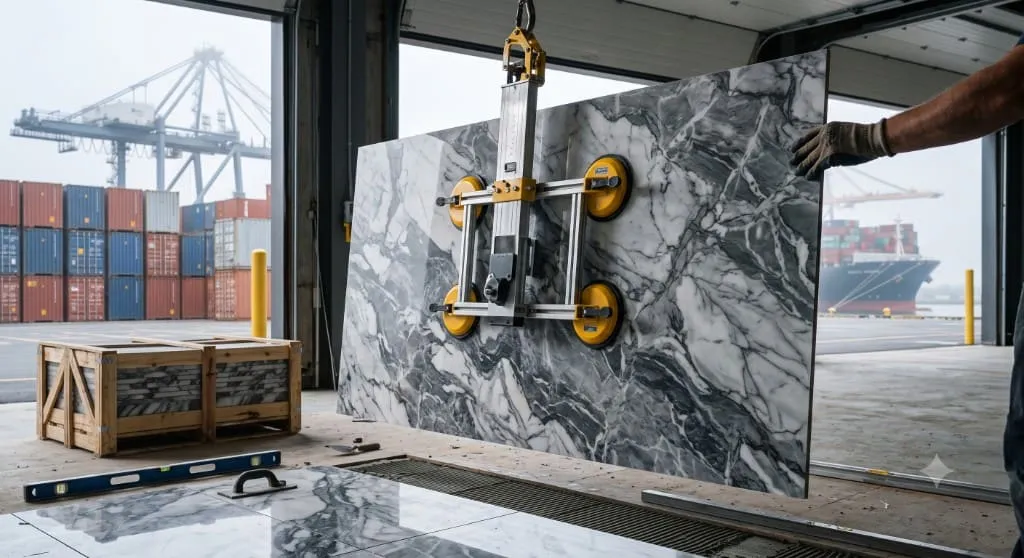
A porcelain tile that ships from western Anatolia on a Tuesday is, five to six weeks later, on a truck crossing the twelve miles from the Newark–Elizabeth marine terminal to our dock in Lyndhurst, New Jersey. Between those two points sit a pressing line, a kiln longer than a city block, a diamond grinding tunnel, a customs filing transmitted before the box is even loaded, and an ocean. This is the whole route, told through one tile — because a buyer who can picture the route negotiates, schedules, and receives better.
Born as powder
The tile begins as a milled blend of clays, feldspar, and quartz — a pale powder with almost no romance to it. A hydraulic press compacts that powder into a slab at pressures measured in hundreds of bars; what slides out is called the green body, dimensionally perfect and fragile as a cracker.
The face comes next, and this is where the last decade rewrote the industry. Digital inkjet lines print the surface — a Carrara vein, a weathered cement, an onyx bloom — the way a press prints a magazine page, from scanned originals broken into dozens of unique faces so the pattern does not visibly repeat. (We covered why face count decides realism in our marble-look comparison.) Glaze is applied over the print, and the slab enters the kiln.
A modern roller kiln runs well past 1,200°C (2,190°F) and moves tile through continuously; a piece enters raw and emerges vitrified in about an hour. The heat is the whole secret of porcelain: the body fuses until it stops being compacted powder and becomes something closer to engineered stone, with water absorption below half of one percent.
Ground square, sorted hard
Fired tile shrinks, and never perfectly evenly — so the best lines send every piece through a rectification tunnel, where diamond wheels grind all four edges back to one exact dimension with a square profile. This single step is what allows the 1/16″–1/8″ (2–3 mm) joints that large-format design depends on; we wrote a full explainer on rectified tile for anyone specifying it.
Then the machines judge the work. Cameras compare every face against the shade standard; planarity sensors measure bow and wedge; pieces sort into tone and caliber lots that will follow the tile on its box label for the rest of its life. Quality in this industry is not an inspection at the end — it is a sequence of rejections along the line. What reaches the packing station has survived all of them.
Boxes, corner boards, stretch wrap, pallet. A 60×120 cm (24″×48″) pallet leaves the mill at 43.2 m² (465 sq ft) and roughly 1,020 kg (2,250 lb).
The paperwork sails first
Here is the part of the journey most buyers never see: before the container is loaded at the mill, its data has already crossed the Atlantic. US customs requires an ISF ("10+2") filing — importer, seller, origin, container stuffing location, and more — transmitted before the vessel is loaded in Turkey. Miss it and the penalty arrives before the tile does.
The physical loading follows the discipline we described in the container buying guide: pallets braced and dunnaged, weights balanced against US road limits, loading photographed, doors sealed, seal number recorded. Then a truck runs the container to port — Gemlik, Izmir, or Istanbul's Ambarlı, depending on the mill — and the ocean leg begins.
The Atlantic, and why New Jersey
Transatlantic services put Turkish cargo into the Port of New York and New Jersey in roughly 25–35 days. For tile bound to US East Coast distribution, that port is not one option among several; it is the shortest line between Anatolian production and the country's densest construction markets.
Our operation sits in Lyndhurst, about twelve miles from the Newark–Elizabeth terminal. The distance matters more than it sounds: drayage — the truck move from terminal to warehouse — is priced by distance and by how quickly a container can be turned. Short drayage means lower cost per load, faster availability after customs release, and no rail leg adding days and handling damage to a product that is, for all its hardness, brittle at the corners.
Clearing customs, in plain English
When the vessel discharges, the entry our broker filed meets the container at the terminal. Duty is assessed — porcelain tile enters under HTS chapter 69 — along with the small standing fees of importation. Most containers release on documents alone; some are selected for exam, which is routine and survivable when the paperwork and the packing list agree with the physical load. Clean documents are not bureaucracy; they are speed.
Release triggers the last mile: a chassis under the box, the short run up the Turnpike, and receiving — where the discipline of photographs and delivery-receipt notations decides, in advance, any claim that ever needs making.
What "direct" actually buys
Follow the route end to end and the value of directness becomes arithmetic rather than slogan. Every intermediary between the kiln and the buyer adds a margin, a warehouse touch, and a delay in answering the only questions that matter: which lot, which caliber, when does it land. A direct program answers them from the source — and demands, in exchange, exactly the process this article describes.
That process is the company. The collections it carries — from Serenity's polished formats to Cementino's matt concretes — are chosen at the mill and accountable at our dock. How we structure that for distributors and project buyers is on the partners page; a conversation starts with a quote request.
FAQ
- Where is Turkish tile made?
- Production concentrates in western Anatolia, with mills clustered in the ceramic districts inland of the Marmara and Aegean coasts — positioned within a truck day of the export ports of Gemlik, Izmir, and Ambarlı.
- How long does tile take to ship from Turkey to the US?
- The ocean leg runs roughly 25–35 days to the Port of New York and New Jersey. With production, export clearance, and customs release included, a realistic order-to-door timeline is six to eight weeks.
- Why does the port of entry matter for tile?
- Tile is heavy, margin-sensitive freight: every extra mile of drayage and every additional handling adds cost and breakage risk. Entering at the port nearest final distribution — for the East Coast, Newark–Elizabeth — keeps both to a minimum.
Featured collections