Materials & Technical · June 15, 2026 · 3 min read
What "Rectified Tile" Actually Means (and When It Matters)
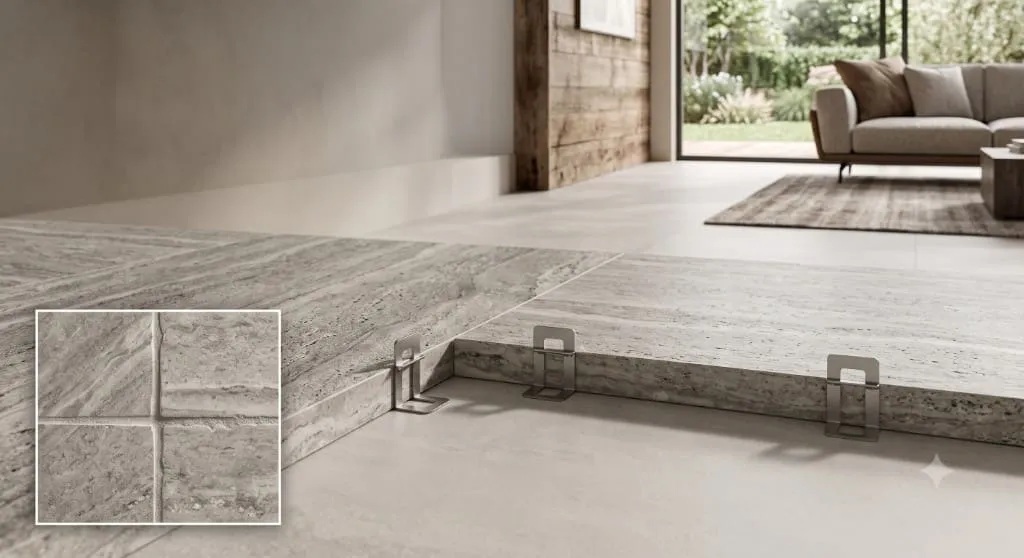
Rectified tile is tile whose edges have been mechanically ground after firing so that every piece is precisely the same size, with sharp, square edges. The point of that precision is the grout joint: rectified tile can be installed with joints as narrow as 1/16″–1/8″ (2–3 mm), where non-rectified tile needs 3/16″ (5 mm) or more to absorb its size variation. That single difference drives most of what the word means on a jobsite.
Why tile needs rectifying at all
Every ceramic product shrinks in the kiln, and it never shrinks perfectly evenly. Two tiles from the same production run can leave the kiln a millimeter or two apart in actual size — which is why manufacturers sort fired tile into calibers, batches grouped by real measured dimension. An unrectified 60×60 cm (24″×24″) tile is nominally that size; its true edge length depends on the caliber stamped on the box.
Rectification removes the variation instead of sorting it. After firing, the tile passes through diamond grinding wheels that cut all four edges back to one exact dimension with a square 90° profile. What was "60×60, give or take" becomes 60×60, full stop — across the box, the pallet, and the reorder six months later.
What the tight joint buys you
A narrow joint is not just taste, though it is also that. On large formats — the 60×120 cm (24″×48″) slabs covered in our cm-to-inch size guide — wide grout lines visually chop the surface back into a grid, defeating the reason large format was chosen. Tight joints let the floor read as continuous stone.
The practical gains are just as real: less grout to maintain and stain, cleaner alignment against long sightlines, and predictable layout math, since every tile contributes an identical module. Nearly all of the GoodzHub catalog — collections like Serenity and Cementino — is rectified porcelain for exactly these reasons; it is the production standard of modern Turkish mills we covered in our sourcing guide.
One honest caveat: a tight joint forgives nothing. With only 1/16″ of grout to absorb error, substrate flatness and lippage control do the work that wide joints used to do. The usual spec is 1/8″ of flatness variation in 10 ft (3 mm in 3 m) for large-format installation — a crew that meets it will love rectified tile; a crew that doesn't will blame it.
When you can skip it
Rectified is not a synonym for better; it is a synonym for precise. Skip the premium when precision isn't the point:
- Rustic and handmade looks, where irregular edges are the design and a wider joint reads as intended character.
- Small formats — on a 20×20 cm (8″×8″) tile the joint-to-face ratio is already high, and caliber variation across a short edge is minor.
- Utility spaces where the floor is a work surface, not a design statement, and installation speed matters more than a 2 mm joint.
- Exterior sand-set work, where joints are wide by design for drainage and movement.
Reading it on a spec sheet
Manufacturers signal rectification in slightly different words. On a Turkish spec sheet you will see rectified or rektifiye; Italian sheets may say rettificato; some brands write "monocaliber," which means the same thing achieved the same way. Three checks worth making:
- The word itself — "rectified" in the product description or the technical table. Every GoodzHub product page states it in the material line.
- Edge profile — rectified tile is square-edged; pressed (non-rectified) tile usually shows a slightly cushioned or eased edge.
- Recommended joint — a manufacturer minimum of 2 mm (1/16″) is itself a statement that the tile is calibrated to hold it.
If a project mixes sizes from one collection — a 60×120 field with a 30×60 cm (12″×24″) border, say — confirm both formats are rectified, so the modules align without the joint compensating.
FAQ
- What is the difference between rectified and non-rectified tile?
- Rectified tile is ground to an exact size after firing, so all pieces match and joints can run 1/16″–1/8″ (2–3 mm). Non-rectified tile keeps its natural kiln variation, is sorted into calibers, and needs joints of 3/16″ (5 mm) or more to hide the difference.
- Does rectified tile cost more?
- The grinding step adds production cost, so like for like it prices above non-rectified tile — but on modern large-format porcelain lines, rectification is the default rather than an upcharge, and the installed look is usually the reason the format was specified at all.
- Can rectified tile be installed with wide grout joints?
- Yes. Rectification sets the minimum joint, not a maximum — a designer can run a 3/16″ (5 mm) joint on rectified tile for effect. The reverse is the real constraint: non-rectified tile cannot safely run tight joints.
Featured collections